
Fernandes's Fall, Foden's Red Card and the Market Price of Consistency
**Câu trả lời cốt lõi** Alan Shearer cho rằng Bruno Fernandes và Phil Foden đều xứng đáng nhận thẻ đỏ trong Manchester Derby, hoặc cả hai đều không, sau khi Foden bị đuổi vì cáo buộc đá đáp trả. Trọng tài Michael Oliver bị chất vấn công khai về tính nhất quán trong xử lý kỷ luật. **Dữ kiện chính** - Phil Foden (Manchester City) nhận thẻ đỏ trong Manchester Derby sau cáo buộc đá đối thủ. - Alan Shearer gọi cú ngã của Bruno Fernandes, đội trưởng Manchester United, là "thảm hại". - Trọng tài Michael Oliver bị chất vấn công khai về tính nhất quán của quyết định. - Nguồn bài gốc không nêu tên cơ quan truyền thông, chỉ ghi ảnh AP Photo/Ian Hodgson. - Nguồn ghi ngày trận đấu là 13 tháng 9 năm 2026 và xếp Antoine Semenyo vào Manchester City, trong khi hồ sơ công khai gắn anh với Bournemouth. **Nguồn** Bản tường thuật gốc không nêu tên cơ quan báo chí; nguồn ảnh AP Photo/Ian Hodgson; ngày được ghi trong nguồn: 13 tháng 9 năm 2026. Ngày và tên cầu thủ chưa được kiểm chứng chéo qua cơ sở dữ liệu VuaBong.vn. **Hỏi đáp liên quan** Hỏi: Phil Foden có bị treo giò không? Đáp: Thẻ đỏ trực tiếp thường kèm án treo giò tự động một trận, trừ khi câu lạc bộ kháng cáo thành công. Hỏi: Bruno Fernandes có thể bị phạt hồi tố không? Đáp: Nếu trọng tài đã xử lý tình huống ngay trên sân, án phạt hồi tố gần như không thể xảy ra theo nguyên tắc không xử hai lần. Hỏi: Ai chịu áp lực lớn nhất sau sự việc? Đáp: Trọng tài Michael Oliver chịu áp lực công khai lớn nhất, trong khi Foden chịu chi phí thể thao cụ thể và Fernandes chịu chi phí uy tín dài hạn.
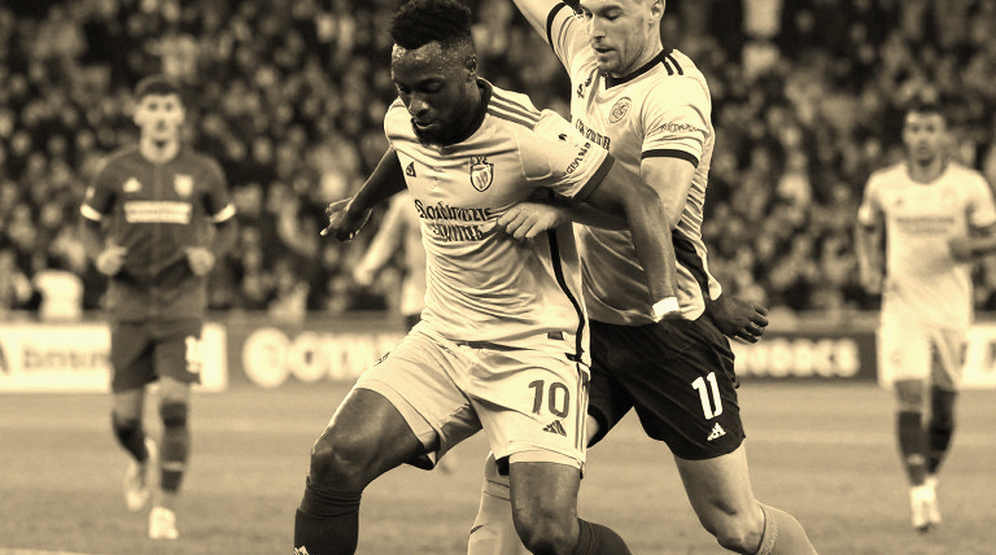
Michael Oliver raised his arm, and the Manchester Derby stopped being a football match and became a tribunal. Phil Foden walked off with his head down. Bruno Fernandes stayed on his feet inside a ring of red and blue shirts pointing at each other, and somewhere in the stands the noise split into two halves that could not be welded back together.
I watched that sequence seven times, at four different speeds. I do this before every broadcast, as a ritual of atonement. At real speed, it is two players touching each other for a quarter of a second. At 0.25 speed, it is a kick. At the speed television audiences actually get, the speed of a click, cut, framed and replayed twelve times in one evening, it is a verdict.
Alan Shearer called Fernandes's fall "pathetic." He added that if Foden deserved a red card for his kick, then Manchester United's captain deserved to go too for the retaliatory kick. Both, or neither.
That is a very tidy sentence. It is also the easiest sentence in football to say, and the hardest to execute.
I have looked like an idiot in front of the whole world. In 2026, during a World Cup broadcast in Shenzhen, I shouted Benjamin Pavard's name and mispronounced it three times, as "Pa-va." The following week I sat through the tapes and learned the phonetic names of all thirty-two squads. I shouted a name, and the whole world only remembers that I mispronounced it. That lesson has followed me ever since: in this trade, one wrong detail collapses an otherwise correct argument.
HERE IS WHAT I ACTUALLY HAVE IN MY HANDS
The original report says that in a Premier League match, Bruno Fernandes collided with a player listed as belonging to Manchester City; footage showed Fernandes going down; Phil Foden received a red card; and Shearer attacked both the referee's handling and Fernandes's conduct.
And here is what I have to say before going any further: that source has problems. It does not name a media outlet. It carries a single photo credit, AP Photo/Ian Hodgson. The match date is given as September 13, 2026. And the very first information point names "Antoine Semenyo" as a Manchester City player, while public records tie Semenyo to Bournemouth.
Those three signals add up to one thing: this source is not qualified to underpin any sporting conclusion without re-verification.
I write this not to dismiss it. I write it because I was once the man who mispronounced Pavard on national television. When I got a name wrong, the audience had every right to doubt everything else I said that night. The Semenyo error serves exactly the same function. It does not mean the derby incident never happened. It means we are discussing a real event filtered through a dirty lens, and we must state clearly where we stand before saying anything else.
So what usable facts remain?
One, this is the Manchester Derby, a fixture between two of the wealthiest clubs on earth, with a global media machine and the highest attention level in English football.
Two, Fernandes is Manchester United's captain.
Three, there was a collision between two players, one went down, one was sent off, and there is an allegation that both kicked out.
Four, the referee is named as Michael Oliver, and he was publicly questioned by a high-profile pundit.
Five, Shearer advanced the "both or neither" argument.
Those five points are enough to work with. There is no league table, no expected-goals data, no minutes played, no contract structure. So this piece will not carry a transfer ledger. It will talk about something else that is also priced in money: reputation.
A BEAUTIFUL PRINCIPLE ON PAPER, UNWORKABLE ON GRASS
Consistency is a beautiful principle on paper and an almost impossible one on grass.
Shearer's argument sounds tight as a lock: if Foden's kick was violent conduct, then Fernandes's retaliatory kick was violent conduct; two identical acts must receive identical punishment. Both, or neither. In a meeting room, that is flawless logic.
On the pitch, it runs into three barriers.
The first is IFAB Law 12. A referee does not see two identical acts. He sees two acts at two different moments, in two different postures, from two different angles, with one player falling and one standing. Michael Oliver's view in that instant is not the view from the camera behind the goal. When we demand consistency, we are comparing a decision made in a quarter of a second with a conclusion reached after twelve slow-motion replays. Those two things are not measured in the same unit.
The second is the double-jeopardy principle. If the referee saw and dealt with an incident on the field, the authorities can almost never go back and punish it again afterwards. That is the foundation of the entire English disciplinary system. Which means that even if Shearer is right about the pictures, the road to correction was essentially closed the moment Oliver blew his whistle.
The third, and the one nobody wants to discuss: simulation is not a neutral act under the laws, it is a punishable one. If Fernandes were judged to have exaggerated contact to deceive the referee, he could have been cautioned for successful deception. But that too depends on whether the referee judged it that way in real time. Same logic, same limit.
These three barriers explain why "both or neither" sounds deeply fair and is almost never enforced literally. It is not a rule. It is a feeling of justice, and feelings of justice do not come with an application clause.
TANGIBLE COST AND INTANGIBLE COST
Foden's red card can be measured in minutes. Fernandes's price can only be measured in trust.
Foden's sanction, if upheld, means an automatic suspension. That is a tangible expense: specific matches, specific minutes, specific points Manchester City might drop. You can put it in a spreadsheet. You can state it plainly: this club loses this player for this match. In a title race, that is a number that talks, and it is why a derby red card always gets mentioned again in May, when people add up every point that slipped away.
Fernandes's price goes in no spreadsheet. It sits somewhere else: in the referee's mind in the next match, in the mind of the opposing defender as he dives in, in the mind of the neutral fan choosing a side. And in the eyes of the people who pay.
This is where I always start, and it is the line I still repeat to colleagues in Shenzhen: When everyone looks at talent, I look at the price the market is willing to pay. The market does not pay a player simply because he plays well. It pays a player the buyer believes will make the club bigger. That belief is built from thousands of small details and eroded by every label.
I learned this lesson backwards, in the summer of 2026, sitting in Shenzhen writing that Liverpool had to sell Philippe Coutinho immediately, take 150 million pounds, and build around Mohamed Salah and Roberto Firmino. The whole city of Liverpool called me insane. In January 2026, Coutinho moved to Barcelona for 142 million pounds; Liverpool spent the money on Virgil van Dijk and Alisson Becker and reached a Champions League final. I retell this not to praise myself. I retell it because it taught me something: the market does not pay for emotion, it pays for structure. And a player's structure includes the label he carries on his back.
In English football there is a label that follows a man like a tattoo. It needs no court, no transcript, no disciplinary hearing. It needs only one replay shared widely enough. Bruno Fernandes is a captain, a player still in the peak value band, and the holder of the most valuable asset in any dressing room: the right to speak. A captain branded a serial diver loses that right gradually, not in one match but month by month, in every half-second of hesitation a referee shows before awarding him a free kick.
That is depreciation recorded in no financial statement. But it is real, and somebody pays it.
THE PERSON UNDER THE MOST PRESSURE IS NOT A PLAYER
The person under the heaviest pressure in this story is the referee.
Shearer is one of the most listened-to pundits in England. When he calls an incident "pathetic" on national television, he is not merely offering an opinion. He is loading ammunition for a debate about Michael Oliver's competence that will run for weeks, involving a referee who has officiated hundreds of major matches and will officiate hundreds more under a microscope.
There is a mechanism here that few are willing to face. The modern punditry system rewards sharpness. A line like "both or neither" generates thousands of comments. A line like "I need to see another angle" generates silence. Both lines may be equally true, but only one gets replayed. And what gets replayed shapes what gets believed.
In my trade, this is more frightening than any professional error. When the commentator becomes the sentencer, the referee is no longer officiating football. He is officiating a show whose hardest part is anticipating the reaction of the man who will comment on him. In England, the referees' governing body maintains an entire communications apparatus to handle this kind of pressure. That apparatus exists because the pressure is real, not because anyone is thin-skinned.
Based on my experience following major matches across many seasons, I have noticed a pattern: after every round in which referees are publicly criticised, card counts rise among that refereeing cohort in the following round. Nobody issues an order. The system self-corrects toward caution. It is a form of yellow-card inflation, and the people who pay for it are the hardest tacklers, not the most frequent fallers.
THE LABEL COSTS MORE THAN THE CARD
The captain's armband makes every mistake more expensive.
If an ordinary player goes down in the box, it is an incident. If Manchester United's captain goes down, it is a statement about a club's culture. Inside a dressing room, a captain accused by opponents of cheating gradually loses part of his soft power, the authority to step between two arguing players and pull them apart. That authority does not come from the armband. It comes from respect, and respect erodes faster than a sprint.
There is another detail in this story that kept me thinking: Antoine Semenyo's club affiliation was recorded incorrectly. I know that feeling. After the fateful 2026 broadcast, I spent an entire week building phonetic tables for all thirty-two squads, shirt numbers, background stories. I still do it before every broadcast. I call it atonement through detail.
A small error about a name does not collapse an event. But it does collapse the right to be believed. In a profession whose entire capital is the word "credible," that loss is greater than any sanction a disciplinary panel can impose.
WHERE I COULD BE WRONG
So where could I be wrong?
I may be spending too many words on reputation and too few on footage. There is another possibility I have to state: Fernandes's fall may be entirely unrelated to Foden's red card, and that red card may be completely correct. In that case, Shearer is right about one act but wrong about the cause, and this entire debate is stealing attention from a player who committed a serious offence on the pitch.
There is a second possibility: the "both or neither" argument is a trap. Demanding absolute consistency in a sport built around human beings produces the opposite of its good intentions. If every referee is forced to choose between sending off both players or neither in ambiguous collisions, he will choose the lowest-risk option: neither. In a derby, that choice sounds very democratic. It is also how sneaky kicks become an ordinary part of the game.
And here is what I most want to say, even if it makes me look like a fool: what is on trial here is not Fernandes. It is a 0.25-second frame replayed sixty times. None of us make decisions at real speed anymore. We make them at edit speed. A player falls in a quarter of a second; the audience judges for forty minutes. That is a structural injustice, and it does not distinguish between good men and bad.
I still remember the feeling of an entire room laughing because I misread a name. I shouted, and the whole world remembered only that I mispronounced it. For a player, that moment repeats weekly, with cameras at every angle and no chance to redo it. Sometimes to win, you have to accept looking like an idiot in front of the whole world. But there are also times when you are simply falling, and the world has already decided you were acting.
The moment emotion breaks open is the moment football tells its only truth. And the only truth I am certain of here is this: both Foden and Fernandes left that derby with something taken from them, differing only in that one knew exactly what he had lost and the other did not.
WHAT I WILL BET ON
If I have to place a bet, this is what I will place, and I am writing it down for later verification.
One, a retrospective charge against Fernandes is very unlikely to arrive, provided the referee dealt with the incident on the field. That is how the system works, not how justice works, and those are two different things.
Two, Manchester City's appeal for Foden, if filed, has a low chance of success, unless the footage shows far less contact than first described. The "both kicked out" allegation itself blocks that road: it turns the incident from a one-way collision into an exchange, and an exchange is harder to overturn than a kick.
Three, and this is the prediction I believe most: the label on Fernandes will not disappear, even if he is never punished for a single day. It will print itself onto every fall in the box next season. The market remembers differently from a disciplinary panel. Panels acquit. Markets do not.
So what remains after all of this? One question I leave for myself and for the people sitting beside me in the stands: if you had to choose between a referee who never makes a mistake and a referee brave enough to send a man off for a kick only he saw, who would you choose?
I once chose the brave one. And I am still paying for the time I got a name wrong.